
How to Choose a Pet Supplement Manufacturer
-
 admin
admin
- 17th September 2026
Choosing a pet supplement manufacturer is a product, compliance, and supply decision at the same time. A polished sample is not enough: brands need evidence that a partner can translate a brief into a repeatable formula, document the process, and support the product after launch. These twelve questions create a practical interview script for private label, OEM, and contract manufacturing projects.
Which product formats do you manufacture in-house?
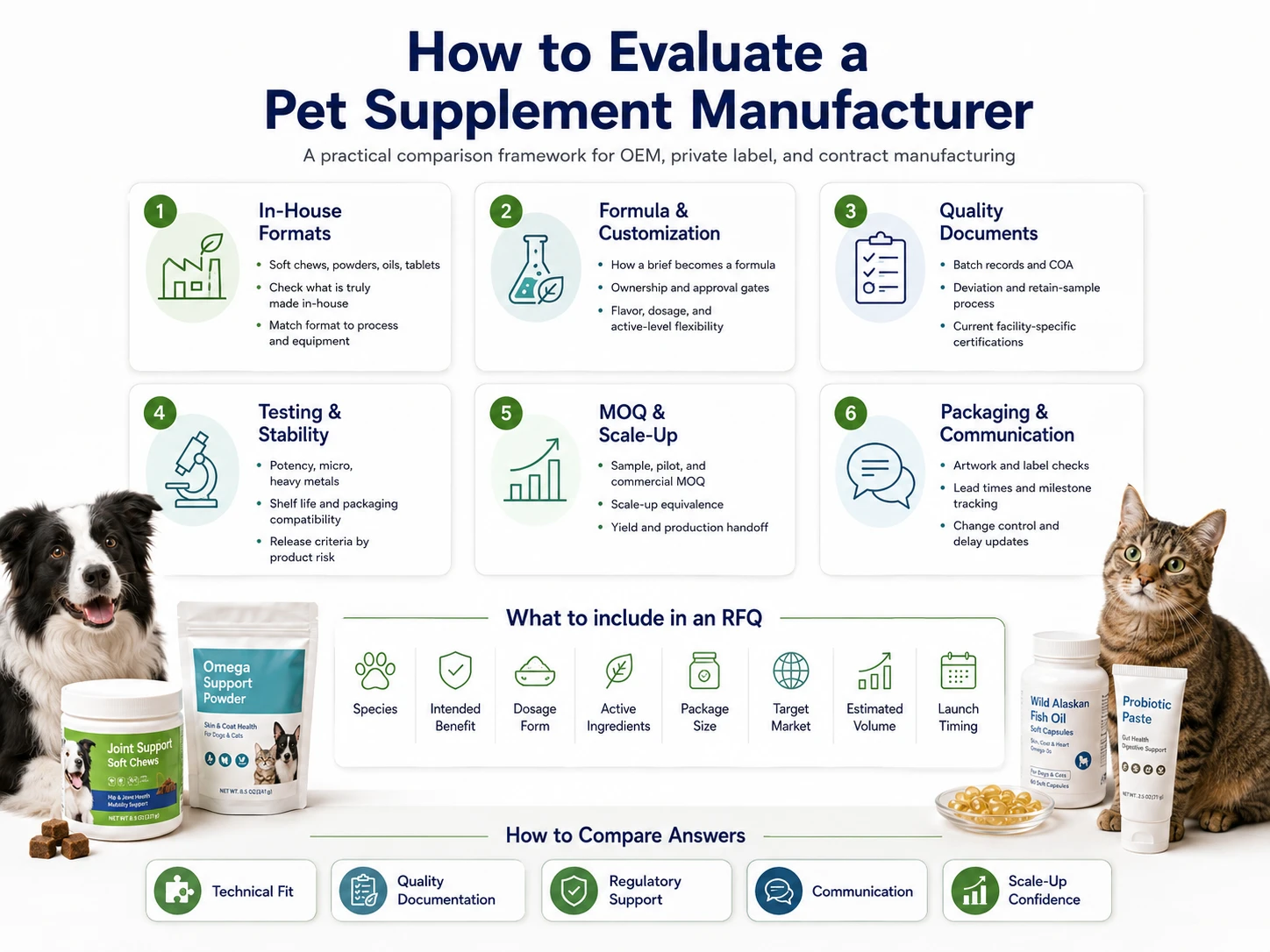
Start with the format because it determines tooling, stability work, packaging, and the owner experience. Ask whether the factory makes soft chews, capsules, tablets, powders, oils, liquids, or emulsions on its own lines, and which steps are outsourced. Match the requested format to documented process, equipment, and batch controls. A verified format range lets a brand build a coherent line instead of changing suppliers for every new SKU.
How do you turn a product brief into a formula?
Request the workflow from first brief to pilot sample: ingredient screening, target species and life stage, dosage logic, palatability, stability considerations, and approval gates. Clarify formula ownership and what changes are included in development. For a joint, gut, omega-3, or multivitamin product, the manufacturer should explain what it needs before proposing a formula. Avoid fixed recipes that ignore intended use, claims, and market requirements.
Can you support both private label and custom development?
Private label can shorten the path to market, while a custom formula can create stronger differentiation. Ask for a clear distinction between stock formulas, modifications, and fully custom development. Confirm whether packaging, artwork, flavor, serving format, and active levels can be adjusted independently. Hs・Viko presents OEM/ODM as a core service; define which decisions are available at each stage and which require a feasibility review.
What quality system and batch records can you show?
Ask for a quality-system overview and a redacted example of the records that will accompany a commercial batch. Useful documents may include incoming-material checks, in-process controls, finished-product specifications, deviation handling, retain-sample practice, and a certificate of analysis template. Do not accept a logo wall as proof. Certifications, registrations, or standards must be current, applicable to the facility and product, and available for verification. For US projects, also confirm how the supplier interprets the relevant FDA requirements; the agency’s official FSMA guidance is a better starting point than a sales summary.
Which ingredients and suppliers are approved for my target market?
Quality of ingredients goes beyond the spec sheet. Ask questions about the qualification process for raw materials, test requirements for identity and contamination, lot tracking, and what occurs on a change of suppliers. With oils, probiotics, botanicals, vitamins, and minerals, ask about potency, oxidative control or moisture control, storage requirements, and retest protocols. If your product will be marketed in the U.S., ask about the label statement review process and whether the intended use aligns with the appropriate animal food construct. A manufacturing company should be comfortable identifying an ingredient or claim requiring regulation.
What testing is performed on every batch?
Get a written testing matrix, not a general promise. Ask which tests are routine for the format and ingredients: identity, potency, microbiology, heavy metals, pesticides, allergens, moisture, oxidation, or probiotic count where relevant. Confirm who performs testing, how out-of-specification results are investigated, and whether the brand receives the final report before release. Testing should match the formula and market, with the rationale and method limits explained.
How do you manage stability, shelf life, and packaging compatibility?
A supplement can pass a release test and still fail in the marketplace if the package does not protect it. Ask how the manufacturer selects packaging, evaluates oxygen and moisture exposure, defines storage conditions, and supports real-time or accelerated stability work. Fish oils and emulsions may need different controls from tablets or powders. Request the proposed shelf-life basis, sampling schedule, and change-control process. If a formula, fill weight, bottle, pouch, or closure changes, ask whether the stability assessment must be repeated.
What are your minimum order quantities and scale-up rules?
Compare MOQ at three levels: development sample, pilot batch, and commercial production. Ask what drives the minimum, such as ingredient lots, tooling, line efficiency, or packaging commitments. Then ask how the process changes when volume increases. The supplier should describe the pilot-to-production handoff, equipment differences, yield expectations, and records confirming equivalence. Low MOQ matters only if the manufacturer can scale without changing the product or documentation standard.
What packaging and labeling support is included?
Clarify whether the manufacturer supplies bottles, sachets, jars, pumps, cartons, labels, or custom tooling, and which components are sourced by the brand. Ask who checks artwork for dosage, net contents, ingredient order, warnings, lot coding, and language requirements. Packaging should protect the formula without overclaiming. Hs・Viko’s catalog spans multiple delivery forms, so request a format-specific recommendation and approval checklist before artwork is finalized.
How are lead times, changes, and delays communicated?
Request a milestone schedule separating formula approval, sampling, artwork, component sourcing, production, testing, and release. Ask what starts the production clock and how delays are escalated. Define the approval owner for formula, flavor, packaging, and final label. A professional supplier records changes in one controlled process. Build contingency around material availability, print cycles, and retesting triggered by change.
What happens when a batch or component does not meet specification?
Ask for the nonconformance and corrective-action process: quarantine, root-cause investigation, disposition authority, customer notification, replacement or rework rules, and preventive action. Also ask how complaints, adverse events, and recalls are logged and traced. A clear process protects the brand’s reputation and gives both parties a defined response when a result is unexpected.
What information do you need for a responsible RFQ?
End the conversation by asking what the manufacturer needs to quote accurately. Prepare target species, intended benefit, dosage form, active ingredients and ranges, flavor or dietary restrictions, package size, annual volume, target market, artwork status, and delivery location. Hs・Viko can be evaluated more fairly when the inquiry includes enough detail for a fit check instead of a generic request for a price list. Ask for assumptions, exclusions, sample costs, testing scope, and the validity period of the quotation in writing.
How to compare answers
Score each manufacturer against the same evidence categories: technical fit, quality documentation, regulatory support, communication, minimums, and scale-up confidence. Separate confirmed facts from promises that still need documents. A short list of strong answers is more valuable than a long list of attractive claims. Review the sample, specification, label, packaging, and commercial terms as one system.
For a structured starting point, review Hs・Viko’s product range and OEM/ODM service pages, then send a brief that allows the technical team to respond to the same twelve questions. For US-market planning, the FDA FSMA guidance and AAFCO startup guidance can help identify questions about product category and labeling responsibilities. A manufacturer should complement, not replace, the brand’s own regulatory review.
Conclusion
The right pet supplement manufacturer earns confidence through evidence: a process that fits the format, records that support release, testing that matches risk, and communication that keeps decisions visible. Use these twelve questions before comparing price. The result should be a partner that can help your brand move from concept to a repeatable product line with fewer surprises.
FAQs
What is the difference between OEM and ODM for pet supplements?
OEM usually means producing to a brand’s defined formula or specification, while ODM commonly includes formulation and product-development support. The exact scope should be written into the project agreement.
Should a startup choose stock formulas or custom formulas?
Stock formulas can reduce development time and complexity. Custom formulas may offer stronger differentiation but require more validation, documentation, and budget. The choice depends on the brand’s positioning and evidence needs.
What should a first RFQ include?
Include species, benefit, dosage form, active ingredients, target market, package size, estimated volume, packaging preference, delivery location, and required launch timing. Clear inputs produce more comparable quotations.
How can a brand verify a manufacturer’s quality claims?
Ask for current, facility-specific certificates where applicable, sample batch records, test reports, specifications, and a documented deviation process. Verify that each document applies to the product and site being quoted.
To request a fit check, contact the technical team with your formula brief, format, target market, package requirements, estimated quantity, and any available artwork or specification.
admin
personal profile







Contact Us