Blog

Our Blog

Hs·viko’s company records document July 2024 doctoral-workstation and practical teaching-base cooperation with Henan University of Animal Husbandry and Economy. Other records describe quality training and Chilean buyers reviewing cat-treat mixing, filling, sealing and checks. These concrete activities help buyers connect a manufacturing discussion with formulation, process and packaging questions.

For brand buyers, turn these considerations into a product brief: target market, intended species, formulation, format, serving measure, packaging and order plan. Hs·viko supports OEM/ODM discussions across soft chews, tablets, capsules, powders, liquids and pastes. A consistent brief makes it easier to compare samples and quotations for the same product concept.
Contact Us

How to Plan a Private Label Pet Supplement Manufacturing Timeline

  • avatar admin
  • 20th November 2026

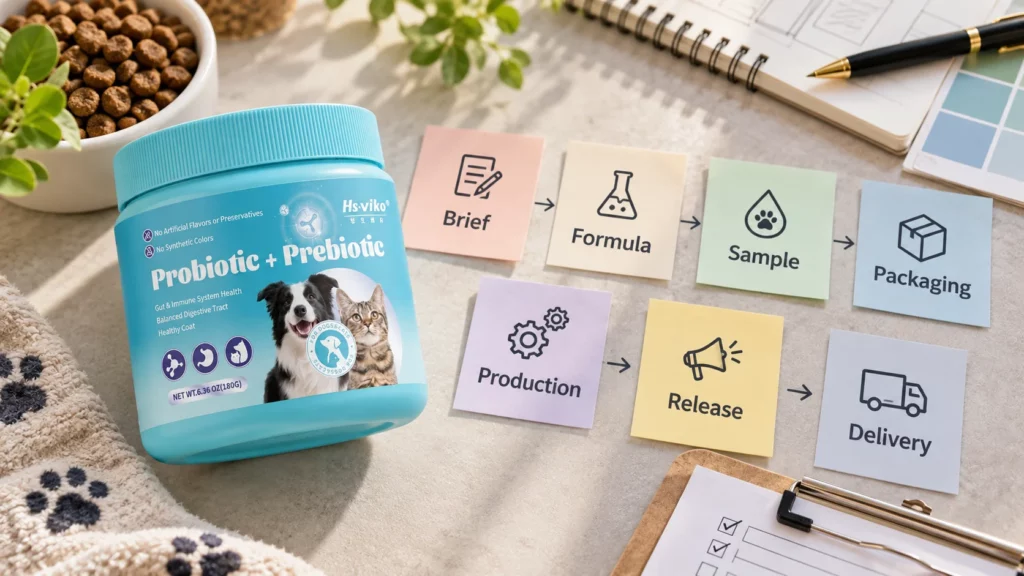
Private label pet supplement production timeline beside the selected product pack

For a first private label pet supplement order, the useful answer is a dated, scope-specific schedule, not a single number detached from its start point. HSVIKO’s startup and e-commerce solution page lists a typical production time of 25-45 days from formula finalization to finished product, depending on complexity and order size. That reference does not by itself tell a buyer when formula work begins, whether packaging approvals are already complete, or when goods will reach a warehouse. Confirm those boundaries before setting a launch date.

What the 25 to 45 day estimate does and does not tell you

The published range starts at formula finalization and ends at finished product. It is therefore a production-planning reference after the formula has been finalized, not a guaranteed concept-to-launch or door-to-door promise. It gives buyers a useful baseline while leaving several project details to confirm in the quotation.

The range is described as typical and dependent on product complexity and order size. It is not broken into fixed durations for sampling, ingredient procurement, artwork, production, testing, or shipment. Ask the supplier to map those activities to your specific order and state which are included in the quoted window. Do not add guessed stage durations together or assume that every project follows the same sequence. For the company-specific reference, see HSVIKO’s published timeline reference

For launch planning, keep three dates distinct: when the product brief is accepted, when the formula and specifications are approved for production, and when released goods are expected at the destination. A supplier may quote only one of those intervals. The purchase order should say which event starts the clock and which event stops it.

Separate product development from the production clock

The project can begin before the manufacturing period shown in a quote. If the formula still needs development, the team may need to resolve ingredient choices, serving size, dosage form, flavor, and acceptance criteria before it can be finalized. A stock or established base formula may reduce the number of decisions compared with a fully custom formula, but the actual schedule depends on the product brief and the supplier’s review. Ask the supplier to quote development and production as separate phases when both are required.

Sample review is another boundary worth naming. If a sample or pilot is part of the approval path, ask whether the quoted production window begins before or after written sample approval. Record who reviews the sample, how feedback is submitted, and whether a formula change triggers a new review. An open approval loop can move a target date even when manufacturing itself is ready to be scheduled.

Packaging and labels also need clear owners and approval dates. Confirm the selected package, artwork version, quantity statement, directions, and destination-market review before the supplier reserves or releases components. If these items are still changing, request an updated schedule rather than relying on a date based on an earlier specification.

Which decisions can move a first order date

A schedule becomes more reliable when the RFQ identifies the product rather than describing it only as a pet supplement. HSVIKO lists soft chews, tablets, pastes, capsules, liquids, and powders; these formats use different production and packaging considerations. The final format should be part of the quote because a powder pouch and a liquid bottle are not interchangeable line items.

For an overview of the available forms, review the company’s pet supplement product range. The supplier’s manufacturing-process guide explains why dosage form, packaging fit, and quality checks need product-specific review. For timeline purposes, ask which of the following conditions affect your quoted date:

  • Formula status. Is the formula already approved, based on an existing option, or still under development? Which sample, pilot, or technical approvals must be complete before production can start?
  • Dosage form and specification. Which form, serving size, fill weight, flavor, and acceptance criteria will the quote cover? A change to one of these details may require a revised plan.
  • Order size and production slot. The published estimate identifies order size as a timing factor. Confirm the quantity by SKU, when the production slot is reserved, and what happens if the order quantity changes.
  • Packaging and artwork. Name the bottle, pouch, jar, tube, sachet, or other selected pack; state whether components and final artwork are approved, and ask whether their sourcing or review sits inside the quoted window.
  • Testing and release. Ask what checks must pass before finished goods are released, who reviews the records, and whether the timeline ends at completed packing, quality release, dispatch, or delivery.

What to request in a written production schedule

Ask for a milestone schedule alongside the unit price. It should be specific enough for your team to track approvals without implying that every task can be compressed or run in parallel. A concise schedule can include:

  1. The start event and end event for the quoted lead time, plus whether days mean calendar days or business days.
  2. The status of formula, sample or pilot, product specification, package components, and artwork at the time of quotation.
  3. The buyer and supplier approval required at each gate, with a target response date and a named contact for open questions.
  4. Any dependencies on ingredient or packaging availability, a production slot, required testing, or a change to quantity or specification.
  5. The date of expected finished-goods release and a separate estimate for dispatch, transit, customs where applicable, and warehouse receipt.

The schedule should also identify its assumptions. If a date depends on the buyer returning an artwork proof, approving a sample, or confirming a shipping instruction, make that dependency visible. If the supplier revises a date, ask which milestone changed and what new approval or material is needed. This is more useful than asking for a faster estimate without defining the work it covers.
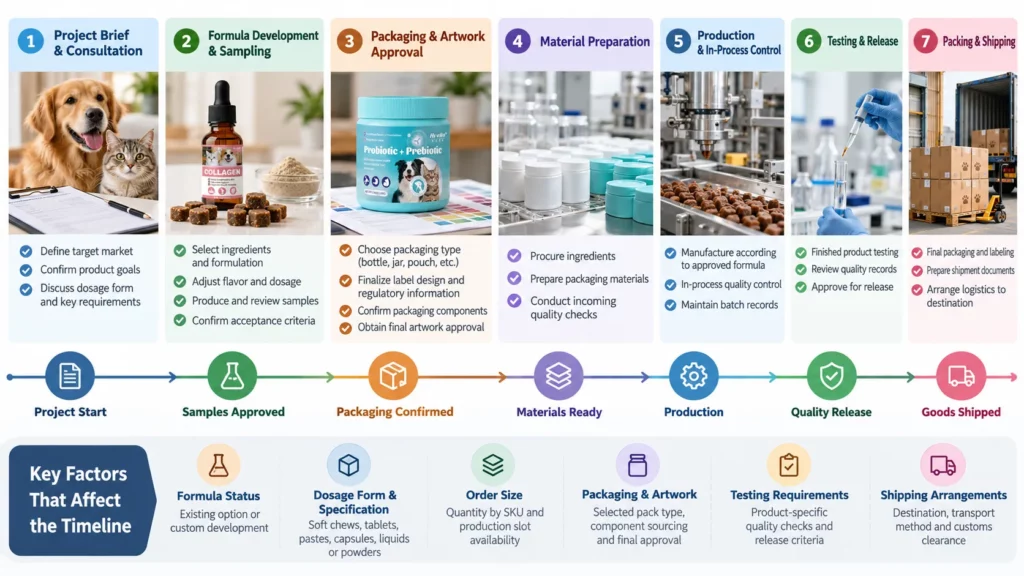
Private label pet supplement manufacturing timeline infographic showing formula development, packaging approval, production, quality testing, and shipping milestones

Plan a launch date with room for decisions

Work backward from the date the product must be available for sale, then protect the decisions that precede production: formula, sample, pack, artwork, quantity, and destination. Keep a written version number for each approved item so the purchasing, marketing, and supplier teams are reviewing the same specification. When one item changes, ask which milestones need to be recalculated.

Do not treat a published range as a fixed delivery commitment. A quote should state the project assumptions and the point at which the supplier will confirm the schedule. If you are comparing proposals, compare like with like: the same formula status, SKU count, order size, packaging responsibility, test scope, and shipping endpoint. A shorter number may simply begin later or stop earlier.

For a repeat order, ask whether the approved formula and packaging remain unchanged and whether materials are available. HSVIKO’s solution page separately gives a typical 20-30-day reorder reference once the formula is finalized and on file. Confirm whether that reference applies to your SKU and whether it ends at finished goods or delivery before using it in inventory planning.

Conclusion

HSVIKO publishes a 25-45-day typical production reference from formula finalization to finished product, with complexity and order size affecting the estimate. A brand should still confirm what lies before that clock, which approvals and checks it includes, and whether freight is counted after finished goods. A milestone-based quotation turns a broad range into a schedule your team can actually manage.

FAQs

How long does a private label pet supplement take from concept to launch?

The published 25-45-day range starts at formula finalization, so it should not be treated as a concept-to-launch estimate. Request a separate schedule for formulation, sample approval, packaging, production, release, and shipping.

Does the 25 to 45 day production estimate include shipping?

The page defines the endpoint as finished product, not warehouse receipt. Ask the supplier to quote dispatch and transit separately and confirm the delivery location.

Can dosage form affect the production schedule?

It can affect process and packaging requirements. Include the exact form, serving, fill weight, and pack in the RFQ, then ask the supplier to confirm any schedule impact.

What should I send to get a project-specific timeline?

Send the formula status, dosage form, serving and pack size, SKU quantity, target market, artwork status, testing needs, and destination. Ask for dated milestones and approval owners.

To request a project-specific fit check, contact the HSVIKO team with your formula status, dosage form, pack specification, quantity by SKU, target market, artwork status, and required delivery location.

avatar
admin
personal profile

Table of Contents

News

Related Posts

Frequently Asked Question

1. Soft Chews: Highly palatable, easy to mix with food, suitable for probiotics, lysine, and daily intestinal immune conditioning for young pets; 2. Soft Capsules: Contains oily liquid, specifically for fish oil and fat-soluble vitamins, with good absorption, the first choice for coat care; 3. Hard Capsules: Filled with high-concentration herbal powder, highly stable, specifically for liver protection, urinary tract health, and oral deodorization; 4. Paste: Liquid and easy to feed, quickly replenishes nutrition, ideal for emergency nutrition replenishment in post-operative, postpartum, and weak/picky pets; 5. Tablets: Standardized dosage, simple to feed, a must-have for calcium supplementation, multivitamins, and joint care; 6. Powder: Highly active fine powder, can be mixed with canned food/goat milk, suitable for high-dose conditioning needs and multi-pet households.
The formulation is differentiated based on the characteristics of the raw materials, absorption requirements, and pet acceptability. Oil-based ingredients may be evaluated in softgels, liquids or other suitable formats according to the formula, stability and packaging requirements; live bacteria and herbal powders can be made into granules, powders, and tablets; for rapid replenishment, ointments are preferred, taking into account palatability, stability, and absorption efficiency.
Suitability, species, age range and feeding amount are confirmed for the approved formula and final label. Please follow the product-specific feeding guidance and consult a qualified professional when needed.
Soft pellets/powder: Mix directly with staple food, canned food, or goat milk; Soft capsules: Pierce to extract oil and mix with meat, cat food, or dog food; Hard capsules: Open to extract powder and mix with wet food; Tablets: Crush and mix with food, or wrap with meat strips before feeding; Pastes: Lick directly, apply to paws, or mix with supplementary food.
For daily health maintenance, administer once a day; during the improvement period (hair loss, soft stools, urinary discomfort, etc.), administer once in the morning and once in the evening; nutritional care products can be fed continuously for a long time without causing dependence.
Different dosage forms have different storage requirements: 1. Soft granules and powders: Store in a sealed, cool, and dry place. High temperatures can cause oil to seep out and clump together. Avoid direct sunlight. 2. Soft capsules: Store away from light and at low temperatures. Refrigeration is recommended in summer. High temperatures can cause them to soften and stick together. 3. Hard capsules and tablets: Store at room temperature in a dry place away from light and moisture. They have a high tolerance for storage errors. 4. Ointments: Refrigerate after opening to prevent oil and water separation and spoilage.
Shelf life and storage guidance are confirmed for the approved formula, packaging and final label.
Hs·viko's entire range of pet nutrition products is hormone-free and contains no irritating industrial palatability enhancers; it uses a food-grade safe preservation system, and the fresh meat and dairy base enhances natural palatability, making it safe for long-term feeding without causing any burden on the body.
It can be used for both dogs and cats; simply control the amount of food according to the weight of each pet.
Physical changes caused by high temperatures during transportation are not considered spoilage; simply let it cool in a cool place. If there is an unusual odor, mold, oil leakage, discoloration, or severe clumping, please contact after-sales service for replacement.
Pet nutrition is a chronic conditioning process. For coat health, intestinal health, and urinary tract health, it is recommended to feed the same products continuously for more than 30 days. At the same time, a light diet with less oily and salty snacks will make the conditioning effect more obvious.
We support OEM/ODM for all categories of products, including soft granules, soft capsules, hard capsules, ointments, tablets, and powders. We can customize formulas, content, packaging, and brand labels, and we have our own complete production line.
We can customize formulas for hair growth, gastrointestinal health, urinary tract health, liver protection, calcium supplementation, immunity enhancement, and post-operative nutrition. We can provide corresponding raw material and finished product testing reports for each batch.
contact-us

Contact Us


    Products
    Contacts
    WhatsApp
    Email