
Fish Oil Softgels vs Liquid vs Emulsified vs Powder for Pets
29th octobre 2026
 admin
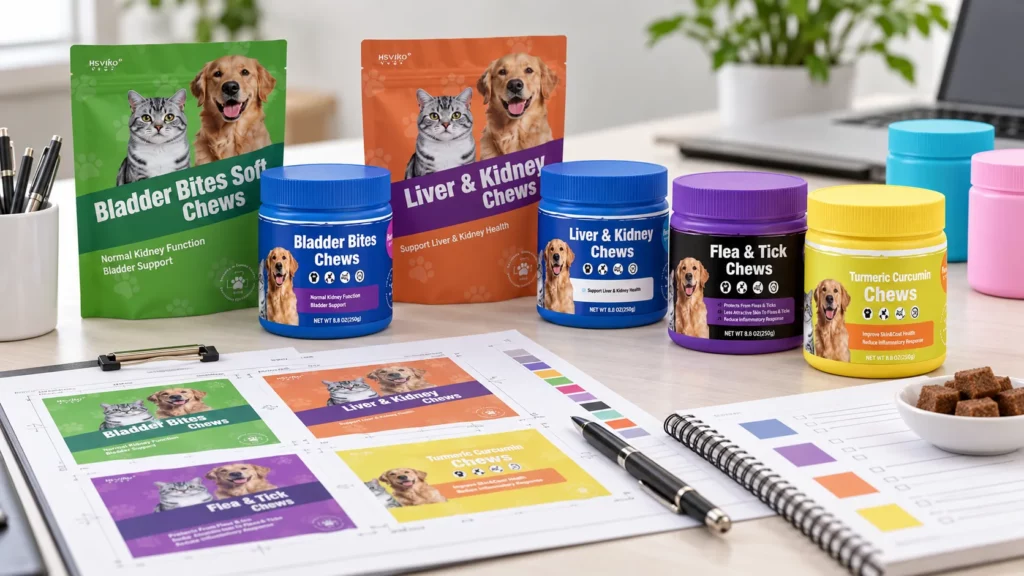
For a U.S. pet brand, pet supplement labeling is an animal-food compliance project, not a copywriting exercise. FDA rules, AAFCO model language, state feed laws, ingredient status, and marketing claims all affect the label. Start by classifying the product, confirming each ingredient and claim, and building artwork around the applicable elements. This guide explains the checks a brand should complete with qualified regulatory support before printing.
The phrase “pet supplement” is commercially useful but is not a universal legal category that makes human dietary-supplement rules portable to animals. AAFCO explains that the Dietary Supplement Health and Education Act (DSHEA) does not apply to animal feeds. FDA regulates animal foods under the Federal Food, Drug, and Cosmetic Act, while states enforce their own feed laws and often use AAFCO model regulations as a drafting reference.
That distinction matters for a product such as an oil, chew, powder, tablet, capsule, liquid, or paste. The format does not decide compliance by itself. The intended use, species, formula, directions, and claims must be reviewed together. A product presented as a source of nutrients for intermittent or supplemental feeding may be handled differently from a product presented as a complete and balanced food, a therapeutic diet, or a drug.
Before design, write a classification brief covering species, life stage, format, feeding pattern, target states, and proposed claims. Review package, website, marketplace, and sales copy together because promotional material may be considered part of the labeling context.
The FDA animal-food labeling guidance points to 21 CFR Part 501 for federal labeling requirements. At the federal level, the label must properly identify the product, state the net quantity, name the manufacturer or distributor and place of business, and list all ingredients. The product must also be safe, truthfully labeled, and not misleading.
Ingredient statements deserve particular attention. FDA requires ingredients to appear by common or usual name in descending order of predominance by weight, subject to applicable exceptions. If an ingredient has an AAFCO-defined name that is accepted for the intended use, use the correct defined name rather than an attractive but nonstandard marketing phrase. Confirm the legal status of each ingredient, additive, color, flavor, carrier, and processing aid before it enters the formula or artwork.
The named guarantor also matters. If another company manufactures the product, make the relationship clear with wording such as “manufactured for” or “distributed by,” followed by the responsible business name and address. Define who owns final labeling, state filings, complaints, and recalls.
AAFCO does not approve individual pet supplements or issue a federal license. Its model regulations and Official Publication are used by many states, so the AAFCO startup labeling guidance is an important working reference. It describes eight required label items for pet foods: brand and product name, species, quantity statement, guaranteed analysis, ingredient statement, nutritional adequacy statement, feeding directions, and the manufacturer or distributor name and address.
Not every item applies in the same way to every supplement. A product conspicuously identified as a supplement, snack, or treat may be exempt from a nutritional adequacy statement, while a product represented as complete and balanced has a different responsibility. Feeding directions may also depend on the product representation. Do not copy a checklist mechanically; determine which statements are triggered by the proposed product identity and claims.
Guaranteed Analysis is not a human “Supplement Facts” panel. AAFCO specifies the nutrients, units, order, and minimum or maximum guarantees that apply to the product type. A voluntary guarantee may be useful when it supports a lawful, substantiated claim, but it should match the formulation, serving amount, and analytical method. A label should not imply a nutrient level that the finished product cannot consistently support.
The highest-risk label error is a disease claim disguised as wellness copy. FDA states that expressed or implied claims to cure, treat, prevent, or mitigate disease, or to affect body structure or function outside food purposes, can establish an intended use as a new animal drug. That can require an approved new animal drug pathway rather than ordinary animal-food labeling.
Claims such as “supports skin and coat health,” “helps maintain normal joint function,” or “provides omega-3 fatty acids” still need to be accurate for the formula, species, serving level, and available evidence. Claims such as “treats arthritis,” “prevents urinary disease,” “stops diarrhea,” or “cures infection” raise a different regulatory question. The same scrutiny applies to testimonials, before-and-after language, icons, product names, and search ads.
Create a claim matrix before artwork: proposed wording, claim type, ingredient and dosage basis, substantiation file, required qualifier, reviewer, and approved channels. When a phrase is uncertain, remove it from the first proof instead of trying to repair it with a disclaimer. A disclaimer does not automatically neutralize an otherwise prohibited drug indication.
Federal compliance is only one layer. FDA directs firms to the states for additional registration and labeling requirements, and the exact process can differ by destination. A state may require product registration, a license, fees, label submission, a state-specific caution, or a particular form of guaranteed analysis. Requirements may also vary by species, product type, distribution channel, and whether the product is sold directly or through a distributor.
Build a destination-state matrix before printing. Track classification, registration status, approved label version, filer, renewal date, and state-specific wording, with version control for artwork. A label accepted in one state is not automatically cleared nationwide.
Review the front and information panels, carton, insert, website, marketplace listing, social posts, and sales sheet together. Check consistent identity, species, quantity, directions, warnings, ingredients, claims, units, lot coding, storage language, and contact information after the final dieline is applied.
For an OEM or ODM project, request the manufacturer’s current specification, ingredient statement, serving basis, package dimensions, and quality documents early enough to review them against the label. HSVIKO presents pet supplement OEM/ODM services, custom formulation, multiple delivery formats, and packaging support; the exact documents and responsibilities for a proposed U.S. SKU should still be confirmed in the RFQ and final quality agreement.

A compliant U.S. pet supplement label begins with classification and claim discipline. FDA provides the federal baseline for animal-food labeling and ingredient declarations. AAFCO supplies model language that many states use, but it is not a federal approval mark. State registration, product-specific guarantees, and the intended use of the product can change what belongs on the package. Brands that resolve those questions before artwork and production reduce avoidable rework and create a clearer record for distributors, retailers, and regulators.
For an OEM or ODM launch, send the manufacturer the species, format, target states, serving concept, draft claims, pack size, and documentation needs. Evaluate formulation and packaging fit against that brief, while keeping final regulatory responsibility explicit between the brand, manufacturer, and qualified reviewer.
There is no blanket FDA pre-market approval category equivalent to a human dietary-supplement label. The product still must comply with animal-food law, ingredient requirements, truthful labeling, and any applicable drug-approval pathway created by its intended use or claims.
No. AAFCO develops model regulations, definitions, and guidance used by many states. A state feed-control authority determines the requirements that apply to products distributed in that state.
Do not assume that human dietary-supplement terminology is appropriate for an animal product. Confirm the product category and state requirements, then use the label format and terminology supported by the applicable animal-food rules.
The answer depends on how the product is represented. Complete and balanced foods have feeding-direction requirements, while products labeled as treats or supplements may be treated differently. Confirm the exact product representation before finalizing directions.
Provide the species, life stage, format, target states, intended claims, serving concept, pack size, ingredient constraints, and required documentation. Ask the manufacturer to identify which specifications and label responsibilities are included in the scope.
When your brief is ready, contact the HSVIKO technical team with the formula direction, species, format, pack size, target quantity, destination states, and claim review requirements for a fit check.
Related Posts
Fish Oil Softgels vs Liquid vs Emulsified vs Powder for Pets
29th octobre 2026
Brand Buying Guide to Private Label Fish Oil for Dogs and Cats
22nd octobre 2026






Contactez-nous