
U.S. Pet Supplement Labeling: An FDA and AAFCO Guide for Brands
30th octobre 2026
 admin
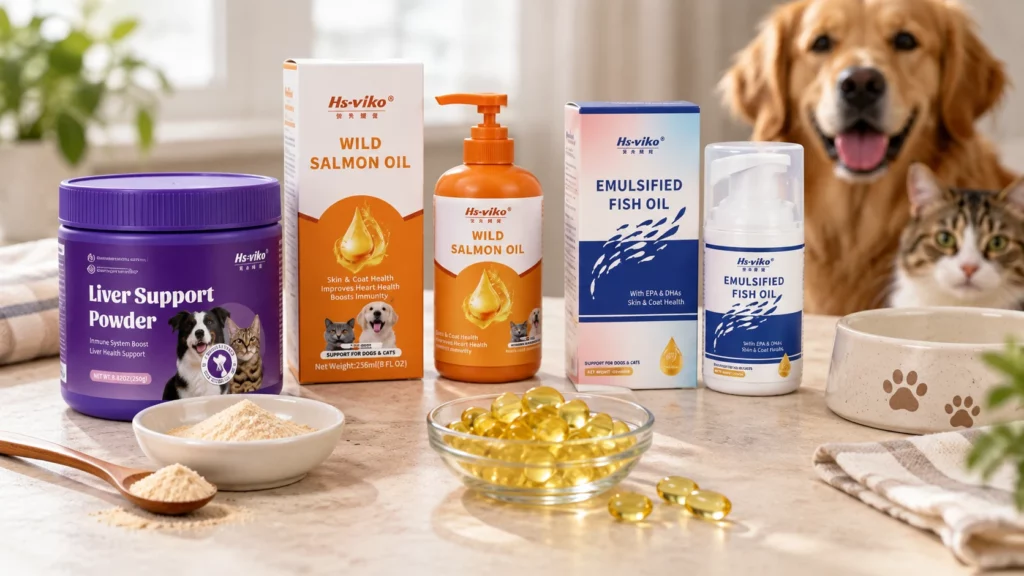
For a pet supplement brand, no fish oil format is universally superior. Softgels provide sealed unit doses; liquid oil supports adjustable serving; emulsified products can create a smoother, lickable or food-mixing experience; and powder offers dry handling when the oil is carried in a suitable powder system. The right choice depends on the target EPA and DHA per serving, the intended feeding routine, oxidation and moisture risks, packaging, and the cost of producing a repeatable specification.
This comparison is for product developers and buyers choosing a delivery system for dogs and cats, not a dosage recommendation. A manufacturer should verify the formula, serving directions, label, test plan, and market requirements before production. HSVIKO’s customized pet fish oil softgels illustrate one confirmed starting format for that discussion.
A format comparison becomes misleading when products are compared only by total fish oil weight. The useful specification is the declared amount of EPA and DHA delivered by the intended serving, together with the oil source, serving size, net fill, and any other nutrients in the formula. A smaller high-strength serving can create different capsule, pump, sachet, and cost options than a larger low-strength serving.
Ask whether percentages refer to the raw material, filled blend, or finished product, and whether EPA and DHA are declared individually or only within a broader omega-3 value. Treat catalog figures as formulation starting points and approve a final written specification for the selected SKU.
A softgel encloses an oil-based fill in a sealed gelatin shell. This format suits brands that want a count-based pack, a consistent unit dose, and less direct contact between the oil and air before use. The capsule may be given whole when appropriate or punctured so the oil can be mixed with food. HSVIKO identifies sealing, precise dosing, and cool, dark storage as relevant format characteristics.
The tradeoffs are unit size, capsule count, shell compatibility, and temperature sensitivity. A high target dose may require a larger shell or multiple units. Request fill-weight tolerances, shell specifications, leakage checks, storage conditions, and protective packaging.
Liquid fish oil is practical when the caregiver needs to adjust the amount or mix the product into food. It can support bottles with pumps, droppers, or measured caps, but each system changes dose accuracy, leakage risk, and the amount of air entering the package after opening. HSVIKO describes its liquid supplement format as suitable for flexible dosing and easy mixing.
The bottle and closure are part of the formulation decision. Confirm fill volume, headspace, light protection, pump output or dropper calibration, tamper evidence, storage, and the expected period of use after opening. Repeated exposure can also make odor more noticeable than in sealed units.
An emulsified product disperses oil within another phase to create a more uniform liquid, cream, or paste-like delivery system. The format can support direct licking, portion packs, tubes, or easier distribution through food. It should not be assumed to outperform every non-emulsified oil; performance depends on the actual emulsion, serving, ingredients, process, and stability data. HSVIKO’s emulsified paste format confirms vacuum-emulsified paste production and notes the need to manage oil-water separation after opening.
Compared with plain oil, an emulsion introduces variables such as emulsifiers, water activity, viscosity, flavor, phase stability, and microbial controls where applicable. Request evidence for separation resistance, package compatibility, storage, and serving consistency. Single-dose and multi-use packages require different in-use evaluations.
Fish oil powder generally requires the oil to be carried, absorbed, or encapsulated in a dry system. That can make scooping, sachet filling, blending, and dry-food application easier, but the carrier system affects how much active oil fits in each gram. Buyers should compare EPA and DHA per finished serving rather than assume that the word powder indicates equal potency to a liquid or softgel.
Dry handling also shifts the main risks toward moisture, clumping, flow, blend uniformity, and dispersion in food. HSVIKO’s powder supplement format identifies adjustable serving and moisture control as practical considerations. For a fish oil powder, also ask for the carrier declaration, oil loading, particle behavior, packaging barrier, and finished-product oxidation limits.
| Format | Strong starting use | Main exposure | Questions for the specification |
| Softgels | Defined unit dose and sealed oil | Heat, shell damage, unit size | Fill weight, EPA/DHA per unit, shell, leakage and pack |
| Liquid | Adjustable amount and food mixing | Air, light, leakage and repeated opening | Pump output, headspace, bottle barrier and in-use period |
| Emulsified | Lickable texture or uniform food dispersion | Phase separation and added formula variables | Emulsion system, viscosity, microbial plan and package |
| Poudre | Dry blending, scoops or sachets | Moisture, clumping and lower oil loading | Carrier, oil load, blend uniformity and barrier pack |
Fish oil is sensitive to oxidation, so format selection must be connected to package design and shelf-life verification. Ask how the system limits oxygen, light, heat, and repeated opening through the unit dose, barrier, closure, headspace, sachet, carton, or storage statement. These measures belong in the specification and testing plan.
Define acceptance criteria for identity, EPA and DHA content, net quantity, sensory condition, physical integrity, and relevant oxidation indicators. Emulsified and powder systems may require additional tests for separation, viscosity, moisture, flow, or dispersion. The exact panel depends on the formula and market, so the manufacturer and regulatory adviser should agree on it before commercial production.

A format succeeds only if the pet owner can use it as directed. Start with the species, body-size range, feeding method, target serving, and pack duration. Then test the real routine: swallowing or puncturing a softgel, measuring a pump, squeezing a sachet, or scooping a powder into a typical meal. Palatability and odor should be evaluated in the chosen format rather than inferred from the raw oil alone.
Avoid selecting four formats simply to create a larger range. Each version can require its own formula adjustment, packaging, stability program, artwork, and minimum order. A disciplined launch often begins with the format that best matches the clearest customer routine, followed by additional formats only when they solve a different use case. The broader pet supplement format comparison can help teams separate fish oil-specific decisions from general dosage-form questions.
Ask each supplier to quote the same defined brief. Include:
A comparable quote should distinguish formulation work, samples, testing, tooling, printed packaging, filling, coding, and export documents. Evaluate HSVIKO’s format options against the exact configuration proposed, and request a written formula and finished-product specification before approving artwork or production.
Softgels are a strong starting point for sealed unit dosing, liquids for adjustable dispensing, emulsified products for a lickable or uniformly dispersed experience, and powders for dry handling. The winning format is the one that delivers the intended EPA and DHA in a practical serving while controlling oxidation, physical stability, packaging risk, and production cost. Compare finished-product specifications, not format names alone.
Neither is universally better. Softgels provide sealed unit doses, while liquids support adjustable dispensing and food mixing. Choose by serving, routine, package, and stability plan.
No universal claim follows from the format name. Absorption depends on the emulsion, ingredients, serving conditions, and supporting evidence. Evaluate the finished product and its data.
Possibly, but the carrier or encapsulation system affects oil loading. Compare declared EPA and DHA per finished serving and the resulting serving size.
Usually not without review. Format can alter carriers, serving size, process, packaging, sensory properties, and stability tests. Treat each version as a separate specification.
For a technical fit check, send the target species, EPA and DHA per serving, preferred format, packaging concept, destination market, opening quantity, and forecast when you contact HSVIKO’s technical team.
Related Posts
U.S. Pet Supplement Labeling: An FDA and AAFCO Guide for Brands
30th octobre 2026
Brand Buying Guide to Private Label Fish Oil for Dogs and Cats
22nd octobre 2026






Contactez-nous