

When Should a Pet Supplement Brand Switch from Private Label to Custom Formulation?
-
 admin
- 6th نوفمبر 2026
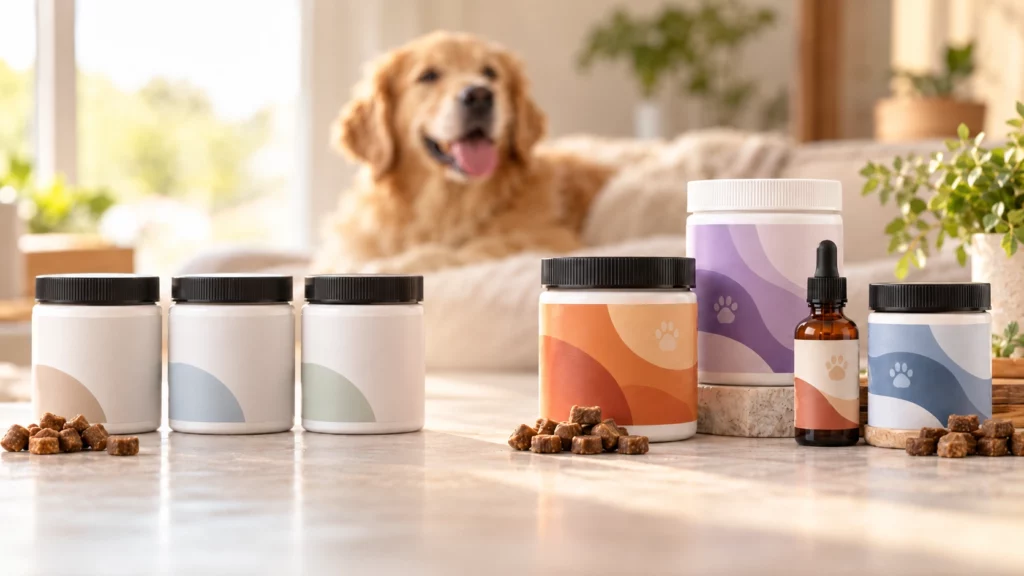
A pet supplement brand should switch from private label to custom formulation when the business has evidence that the category can retain customers, repeated feedback identifies a specific product gap, and the team can manage a more complex development and approval process. The trigger is not company age or a desire to look more premium. It is the point at which a stock formula creates a measurable limit on differentiation, product performance, format, or commercial control – and the expected value of solving that limit justifies the added risk.
The Real Trigger Is Evidence, Not Ambition
Private label is often the right learning system for an early brand. It lets the team test an audience, price, channel, format, packaging concept, and repeat-purchase pattern without designing every technical detail from the beginning. A successful private-label product is therefore not something a brand must outgrow quickly. It can remain the most efficient model for years if customers are satisfied and the formula supports the brand promise.
The broader differences among OEM, ODM, and private-label manufacturing models should be understood before making the change. The transition question is narrower: has the brand learned enough from real sales and product use to write a better specification than the stock product it currently buys? If the answer is still based on assumptions, custom development is premature.
Four Readiness Signals
Demand Is Repeatable, Not Just Promotional
A launch spike does not prove that the formula deserves custom investment. Look for stable reorder behavior, consistent sell-through outside discount periods, and a clear hero product that matters to the business. The relevant evidence may come from direct-to-consumer retention, retailer reorders, subscription continuity, or distributor demand. Customization is easier to justify when losing or weakening that SKU would create a meaningful commercial problem.
Customer Data Points to a Specific Formula Gap
Useful feedback is precise. Customers may repeatedly ask for a different texture, easier dosing, a changed flavor profile, an excluded ingredient, a different concentration, or a format better suited to their pets’ routines. Reviews, returns, support tickets, sampling notes, and retailer conversations should point in the same direction. A vague request for something more premium is not a development brief; a recurring, testable problem is.
The Economics Can Carry Development Risk
A custom supplement formulation can add formulation work, sampling rounds, packaging changes, testing, documentation, and larger inventory exposure. The brand should model the full project rather than compare only unit prices. Confirm that cash flow can support development while the current SKU continues to sell, that the target margin still works at realistic volumes, and that a slower approval cycle will not create a stockout. If the project depends on immediate savings, it is not ready.
Your Team Can Own a More Complex Specification
Custom development transfers decisions to the brand as well as to the manufacturer. Someone must approve ingredient boundaries, serving logic, sensory targets, packaging compatibility, claims direction, change control, and release documents. The team also needs a process for recording why a change was made and which sample became the commercial reference. Without that ownership, customization can produce more versions but less control.
Not Every SKU Should Be Customized
The strongest transition is usually selective. Move the hero SKU when formula differentiation is strategically important, while keeping dependable secondary products on private label. A hybrid portfolio protects working capital and preserves speed for line extensions. It also prevents the business from turning every customer preference into an expensive development project. Customization should concentrate resources where the product itself creates the clearest reason to choose the brand.
Build a Controlled Transition Plan
Development should run beside the current private-label product, not replace it before the new specification is proven. Keep the existing version available while samples, packaging, documentation, and operational handoffs are reviewed. Hs-Viko’s startup and e-commerce manufacturing options describe both private-label starting points and deeper formula customization, which makes a staged discussion possible. The exact scope, ownership, testing, and market requirements should still be confirmed for the proposed SKU.
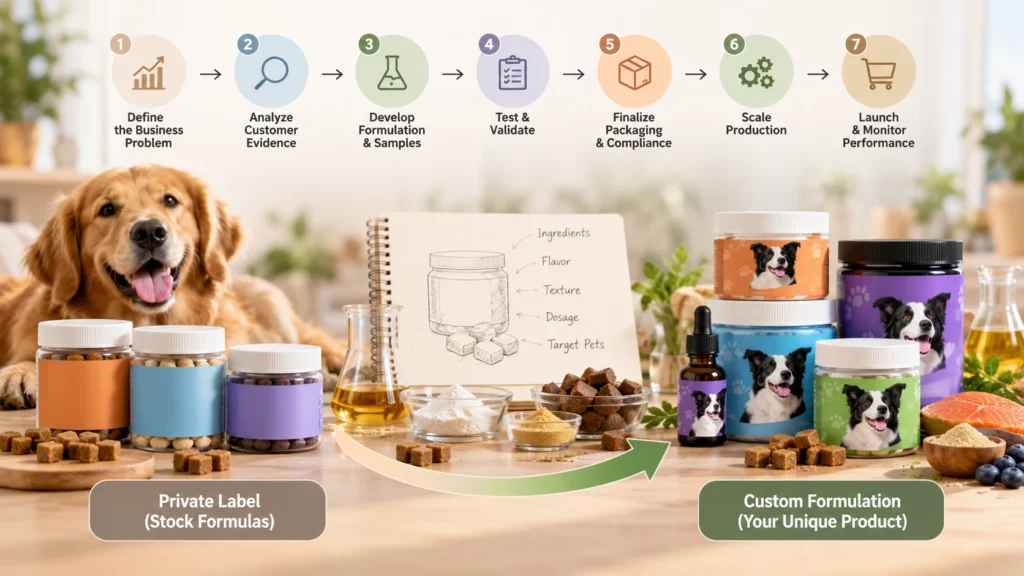
- Define the business problem. State what the stock formula prevents the brand from doing, how often that issue appears, and what result would justify the transition. Separate formula problems from packaging, pricing, advertising, fulfillment, or customer-service problems that formulation cannot solve.
- Translate the evidence into a technical brief. Specify species, life stage, intended support, ingredient boundaries, serving concept, sensory target, pack size, and channel. Review the manufacturer’s available supplement formatsbefore deciding whether the real opportunity is a formula change, a dosage-form change, or both.
- Protect the baseline. Record the current product’s formula reference, label, packaging, customer feedback, complaint pattern, landed cost, and reorder performance. Without a baseline, the team cannot tell whether the custom version improves the product or merely changes it.
- Approve in gates. Review feasibility first, then samples, then packaging and label text, then the commercial batch specification. Define who can approve changes and what evidence is required at each gate. Do not allow late sales requests to alter the formula without repeating the relevant review.
- Plan the market transition. Decide whether the custom product will replace the existing SKU, launch as a premium extension, or enter one channel first. Prepare for possible differences in appearance, aroma, texture, serving size, and instructions, and give customer-facing teams an approved explanation before launch.
Questions to Put in the Manufacturer Brief
A transition brief should make the manufacturer respond to the brand’s evidence, not propose a generic list of ingredients. It should ask for a written distinction between the stock starting point and every requested change, along with the responsibilities attached to development and repeat production.
- Which parts of the formula, flavor system, dosage form, and packaging can change, and which are fixed by process or supply constraints?
- Who owns the final specification, and are exclusivity, reuse rights, or geographic limits included or negotiated separately?
- What sampling, compatibility, stability, palatability, release, or market-specific review may be required for this formula and format?
- How will substitutions, raw-material changes, specification revisions, and future reorders be approved and documented?
- What commercial commitment follows sample approval, including order quantity, tooling or setup, packaging inventory, payment milestones, and reorder conditions?
How Hs-Viko Can Fit the Transition
Hs-Viko presents private label, OEM, and ODM options for pet supplement projects and lists formats including soft granules, tablets, pastes, capsules, liquids, and powders. A brand can use its OEM/ODM development pathway as a starting point for discussing whether to fine-tune a base product or develop a more specific formulation. Product feasibility, ingredient levels, documentation, ownership, packaging, and destination-market requirements should be verified in the written project scope before approval.
الخاتمة
Move from private label to custom formulation when evidence has replaced guesswork: demand is repeatable, customer feedback identifies a specific product constraint, the economics can absorb development risk, and the team is ready to own a controlled specification. Keep private label where it remains efficient. Customize only the products where a better formula or format can create a defensible commercial advantage.
الأسئلة الشائعة
Can a brand keep selling its private-label product during custom development?
Yes. Parallel operation is often the lower-risk approach because it protects supply while the new formula, packaging, documentation, and launch plan are reviewed. The brand should define how inventory and customer communication will be handled when the new version is ready.
Does custom formulation automatically give the brand exclusivity?
No. Formula ownership, exclusivity, reuse rights, and change control depend on the written agreement. A customized version may still use a supplier platform unless the parties explicitly define different rights.
Which product should move to custom formulation first?
Start with a proven hero SKU where recurring customer evidence identifies a solvable product gap. Avoid beginning with a low-volume item or a concept that has not yet demonstrated repeat demand.
What should a brand send to a pet supplement manufacturer?
Send the current product baseline, target species and user, intended support, required and prohibited ingredients, preferred format, serving concept, packaging, target market, order range, customer evidence, and the specific improvement the new formulation must deliver.
When the readiness case is documented, contact the Hs-Viko technical team with the current product reference, target species, desired formula or format changes, packaging, destination market, quantity range, and approval requirements for an initial fit review.
Compare the existing private label concept with the changes the brand actually needs: ingredient profile, serving size, flavor, texture and packaging. Hs·viko materials describe customization across these dimensions. Turn customer feedback into a prioritized development brief, then compare the cost and sample requirements of an adjusted base product with a custom formulation.
For brand buyers, turn these considerations into a product brief: target market, intended species, formulation, format, serving measure, packaging and order plan. Hs·viko supports OEM/ODM discussions across soft chews, tablets, capsules, powders, liquids and pastes. A consistent brief makes it easier to compare samples and quotations for the same product concept.
admin
الملف الشخصي








اتصل بنا