
U.S. Pet Supplement Labeling: An FDA and AAFCO Guide for Brands
30th Outubro 2026
 admin
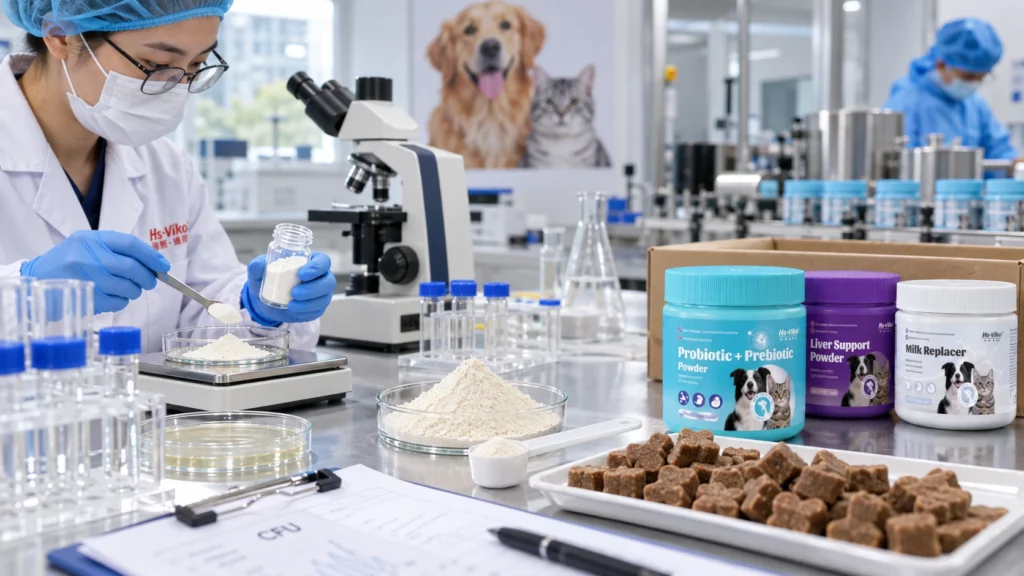
Private label pet probiotics are not defined by a high CFU number alone. A commercially reliable product depends on strain identity, a defensible dose claim, a carrier that protects viability, a format pets will accept, and packaging that preserves the label claim through shelf life. For a brand team, the development question is not simply “Which probiotic should we add?” It is “Which strain-format-package system can be specified, manufactured, tested, and sold in the target market?”
This guide gives buyers and product managers a practical framework for developing dog or cat probiotic supplements with an OEM/ODM partner such as Hs・Viko, while separating catalog-confirmed formats from project details that require formulation and validation.
A probiotic should be identified at the level supplied by the ingredient partner: genus, species, and strain designation where available. “Lactobacillus” or “multi-strain blend” is not a complete technical identity. The specification should also state the intended function, analytical method, carrier, storage conditions, and whether the count is declared per serving, per gram, or per container.
Ask for a current technical data sheet, certificate of analysis, allergen and contaminant information, and documentation supporting the strain identity and intended use. Evidence should match the species, strain, host, dose, and claim being considered. General human or laboratory data should not automatically become a dog or cat claim. Regulatory review remains market-specific; in the United States, the brand should align ingredient and label decisions with qualified review of FDA animal-food requirements e AAFCO guidance for pet-food businesses.
A blend can broaden a concept, but more strains also create more interactions to manage. Compare compatibility, relative abundance, carrier needs, moisture sensitivity, and the ability to assay the finished blend. A simple formula with a clear rationale is often easier to validate than a long ingredient list that cannot be measured consistently.
CFU, or colony-forming units, estimates viable organisms under a defined test method. It is not the same as total cells, weight of powder, or a guaranteed health outcome. A product brief should state whether the target is CFU at manufacture, at release, or through the end of shelf life. “Guaranteed at expiration” and “minimum at production” are materially different commercial promises.
Formulators may use an overage to account for expected loss during blending, processing, shipping, and storage. Overage is not a substitute for stability evidence: too little creates an under-claim, while too much can affect cost, sensory properties, flow, or regulatory review. The final specification should connect the declared CFU, assay method, sampling plan, and acceptance limit.
For private label procurement, request a sample report that makes the unit clear, identifies the test method, and distinguishes the ingredient assay from finished-product results. Do not publish a strain name, CFU count, or shelf-life guarantee until the selected material and packaged formula have been confirmed.
Format changes the risk profile. A dry powder may offer a short ingredient list and flexible serving size, while a soft chew adds palatability and a more visible daily ritual. Liquids or drops can simplify administration for some pets but may expose the organisms to water and oxygen. Capsules and tablets can protect a dry fill, yet they may be less convenient for animals that resist pills.
Powders need control of moisture pickup, segregation, flow, and serving uniformity. A carrier can improve dispersion, but it also changes bulk density and may affect flavor. Define scoop or sachet accuracy, fill weight, reconstitution instructions where relevant, and the package barrier before approving the formula.
Soft chews combine a probiotic with a moisture-containing matrix, so water activity, heat exposure, mixing order, and conditioning become central questions. The active may be added late or protected in a compatible premix, depending on the strain and process. Palatability testing should evaluate aroma, texture, aftertaste, and repeat acceptance in the proposed package.
Liquid or emulsified formats require evidence that the organism remains viable in the finished vehicle, not just in the incoming powder. Capsules and tablets shift the focus toward powder flow, compression or encapsulation stress, disintegration, and moisture ingress. The catalog supplied by Hs・Viko shows probiotic concepts across powder, chew, liquid or emulsified, capsule, and tablet presentations; exact strain-format compatibility is a project decision, not a blanket capability claim.
Probiotics can be sensitive to heat, moisture, oxygen, light, pressure, and time. Stability work should use the final formula, final process, and intended container-closure system. Track viable count alongside appearance, odor, moisture or water activity, texture where relevant, package integrity, and any other quality attribute that could change.
Packaging choices may include high-barrier bottles, pouches, sachets, liners, desiccants, or oxygen-control components, but compatibility must be demonstrated. A desiccant that protects viability may change chew texture or create consumer-use concerns. Repeated opening, headspace, shipping temperature, and warehouse humidity can matter as much as the initial seal.
A useful development plan turns the brief into controlled gates. The partner should identify what is confirmed, what is conditional, and what must be tested before scale-up.

For Hs・Viko projects, the supplied catalog confirms a broad pet-supplement portfolio and multiple probiotic delivery formats. The next RFQ should therefore request the proposed strain documentation, target CFU basis, pilot route, testing plan, package recommendation, and assumptions behind any claim or shelf-life statement. The company’s OEM/ODM workflow can be used alongside its manufacturer-selection guide when comparing development responsibilities.
The strongest private label pet probiotic is a connected system: a correctly identified strain, a clearly defined CFU claim, a viable format, a controlled process, and packaging that protects the result. Use the product brief to expose trade-offs early, require finished-product evidence, and treat every strain, dose, format, and shelf-life statement as a project-specific specification. That discipline gives Hs・Viko and the brand owner a clearer path from concept to a credible commercial product.
CFU means colony-forming units, an estimate of viable organisms under a defined method. The label should make clear whether the count is stated at manufacture, release, or through shelf life.
There is no universal best number. Choose strains for a documented rationale, compatibility, measurable potency, and the claims and format the product can support.
They can be, but a soft chew adds moisture, heat, and matrix interactions. The selected strain and process must be evaluated in the finished chew and package.
The right package depends on moisture, oxygen, light, opening frequency, and format. Barrier performance and stability should be confirmed with the final formula and closure system.
For a project fit check, contacte a equipa técnica da Hs・Viko with the target species, strain brief, CFU basis, format, serving, packaging, market, and required testing documents.
Publicações Relacionadas
U.S. Pet Supplement Labeling: An FDA and AAFCO Guide for Brands
30th Outubro 2026
Fish Oil Softgels vs Liquid vs Emulsified vs Powder for Pets
29th Outubro 2026






Contacte-nos